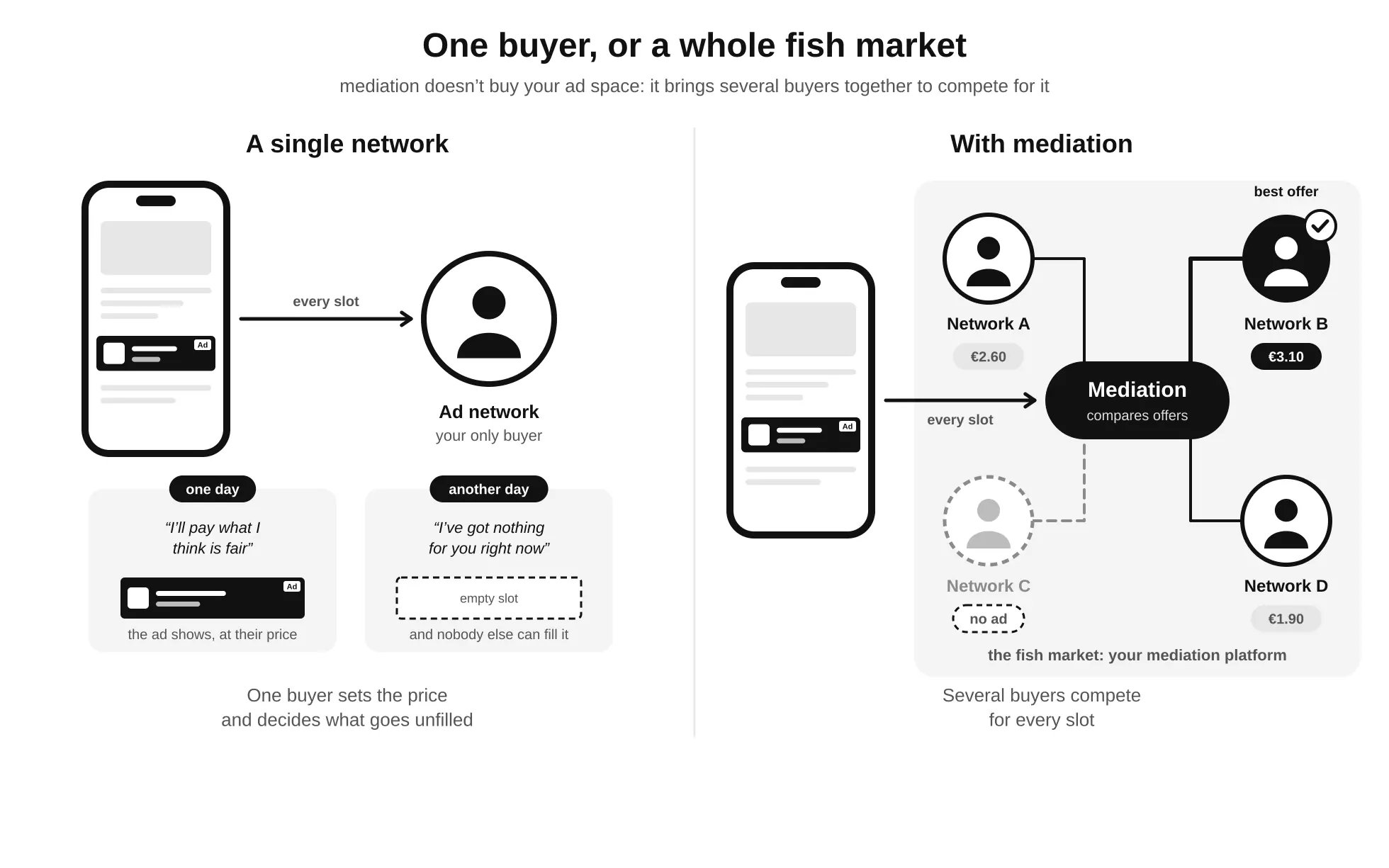
Picture yourself with a small fishing boat, selling your whole catch every morning to the same buyer. They pay a fair price and you’ve never had any trouble with them. But some days they aren’t interested in what you bring in, and you’re left with a crate full of fish. And even on the good days, when they pay well, you have no idea whether someone else would have offered more, because you’ve never let anyone else make you an offer.
Now picture taking your catch to the fish market instead. The market doesn’t buy anything from you. What it does is bring lots of buyers together in one place and let them bid on every crate. If one of them isn’t interested, another one might be. And if two of them are, the price goes up.
An app, website or game that shows ads can be in either of those two situations without even realizing it. If it only works with one ad network, it’s selling all of its ad space to a single buyer. If it uses a mediation platform, it’s taking that space to the fish market.
First, where we’re starting from
To keep things easy to follow, we’ll use the same made-up app that has been with us since the first article in this series . It has around 20,000 daily users who, between them, create around 100,000 opportunities a day to show an ad. With a single ad network integrated, it earns about €184 a day.
In the previous article we saw that the total on its own tells you very little, and that it’s worth breaking the data down, by country for example. So the app’s developer does exactly that, and finds something the total was hiding.
Most of the app’s users, 70% of them, are in Spain. There, an ad is almost always available when the app asks for one, and it pays well: about €3 for every thousand ads shown. The other 30% come from another country, where things look quite different. More than one in five times the app asks for an ad there, the network has nothing to offer. And when it does, it pays just over €1 per thousand. All in all, around 6,600 chances a day to show an ad go to waste.
That raises two questions that a single network simply can’t answer. Is there really no other advertiser, anywhere, willing to pay something for those empty slots? And, more uncomfortable still: if that network pays €3 in Spain, is it because that’s what those ads are worth, or because that’s what it pays, with nobody else to compare it to?
How can an app offer every ad slot to more than one buyer, without having to juggle a different network by hand for every ad?
That’s the question mediation answers.
Before we go on, a quick note for anyone following the series. This is the fifth article. In the first we looked at how the advertising market works. In the second , which monetization model suits each product. In the third , where and when to place ads without ruining the experience. And in the fourth , how to read the numbers to find out where you’re losing money. Now we’re taking things a step further, and shifting our attention from how ads are shown to who’s buying them. Today we’ll focus on what mediation is, what it’s for and, above all, whether it’s right for you. How it works under the hood, meaning how it decides which ad gets each slot, is something we’ll cover in the next article.
Ad networks and mediation platforms aren’t the same thing
The two names sound very alike and people mix them up all the time, but they do different jobs. Let’s pull them apart.
The ad network: the buyer
An ad network is a company with advertisers who want to appear in apps and on websites. Once you integrate it into your product, the conversation between the two is very simple. Your app says: “I’ve got a free slot right now. Do you have an ad to put here?” And the network replies with an ad if one of its advertisers is interested in that slot, or with “I’ve got nothing for you right now” if not.
It’s the buyer from our fishing boat. It brings its own money, its advertisers’ money, and buys whatever it likes at whatever price it thinks is fair. Google’s AdMob is probably the best-known example, and the one we’ve talked about most so far.
The mediation platform: the fish market
A mediation platform doesn’t need to bring any advertisers of its own. Its job is a different one. It brings several buyers together and gets them to compete for every slot in your app.
When your app needs an ad, it no longer asks a network directly. It asks the mediation platform. Mediation checks which networks might be interested in that slot, asks them, compares what each one offers, picks the best offer and hands that ad over to your app. It also keeps a record of what happened, so you can later see who bought, how much they paid and who had nothing to offer.
In short, an ad network buys your ad space; a mediation platform gets several buyers to compete for it.
| Ad network | Mediation platform | |
|---|---|---|
| What it does | Brings advertisers and ads | Gets several networks to compete for every slot |
| The question it answers | “Do I have an ad for this slot?” | “Out of all my buyers, who should get this slot?” |
| When it has no ad | The slot goes unfilled | Another network can try to fill it |
| What it lets you see | How that network performs | How each network performs compared to the rest |
There’s one detail that tends to confuse people at first, so it’s worth clearing up. Many of the best-known mediation tools, AdMob included, are also ad networks. When you integrate AdMob, you start out using its network, with its own advertisers. But if you also turn on its mediation and add other networks, AdMob ends up doing both jobs at once. It runs the fish market and, at the same time, takes part in it as one more buyer. It’s the same tool, but two different roles. Keeping that in mind makes it much easier to understand what you’re seeing in the dashboard.
Why mediation exists
We could start with the technical side, but the reason mediation exists is much simpler than that. No ad network is equally good everywhere.
Every network has its own advertisers, and those advertisers have their own preferences. A network might have loads of advertisers interested in users in Spain and hardly any interested in users in another country. It might pay well on Android phones and worse on iPhones, or the other way round. It might be very strong in one ad format, such as the videos users watch in exchange for a reward, and weaker in another, such as the small ads fixed to the bottom of the screen. On top of that, its demand shifts throughout the year, with campaigns that start and end without warning.
When you work with a single network, you inherit all of its strengths, but all of its gaps too. Whatever it doesn’t cover goes unfilled. Whatever it pays is what you earn. Mediation tries to improve both in the only way possible: by getting more buyers to compete for the same thing.
More networks doesn’t automatically mean more money
It’s worth pausing here, because it’s easy to jump to the wrong conclusion: “if more buyers is better, I’ll add as many as I can”. That’s not how it works.
Every network you add is a bet. It may have hardly any advertisers interested in your kind of product or your countries, and almost never win anything. Its ads may fail to load more often than everyone else’s, or asking it may make the ad take a little longer to be ready. By then, the user may already have moved on to another screen. And every network is one more piece your team has to maintain, with its own privacy rules and its own dashboard.
Back at the fish market, the point isn’t to pack it with people, but to have the right buyers there. A network that never buys doesn’t add competition, only work.
What happens when your app requests an ad
In the first article in the series we took our time following everything that happens from the moment an ad is requested until the user sees it . In that journey, the app talked directly to an ad network. It asked for an ad, the network looked through its advertisers and replied. Now we’re going to retrace the same path, but with mediation in the middle. You’ll see that many of the steps look alike, although a few details can change the outcome quite a bit.
Your app reaches a good moment for an ad
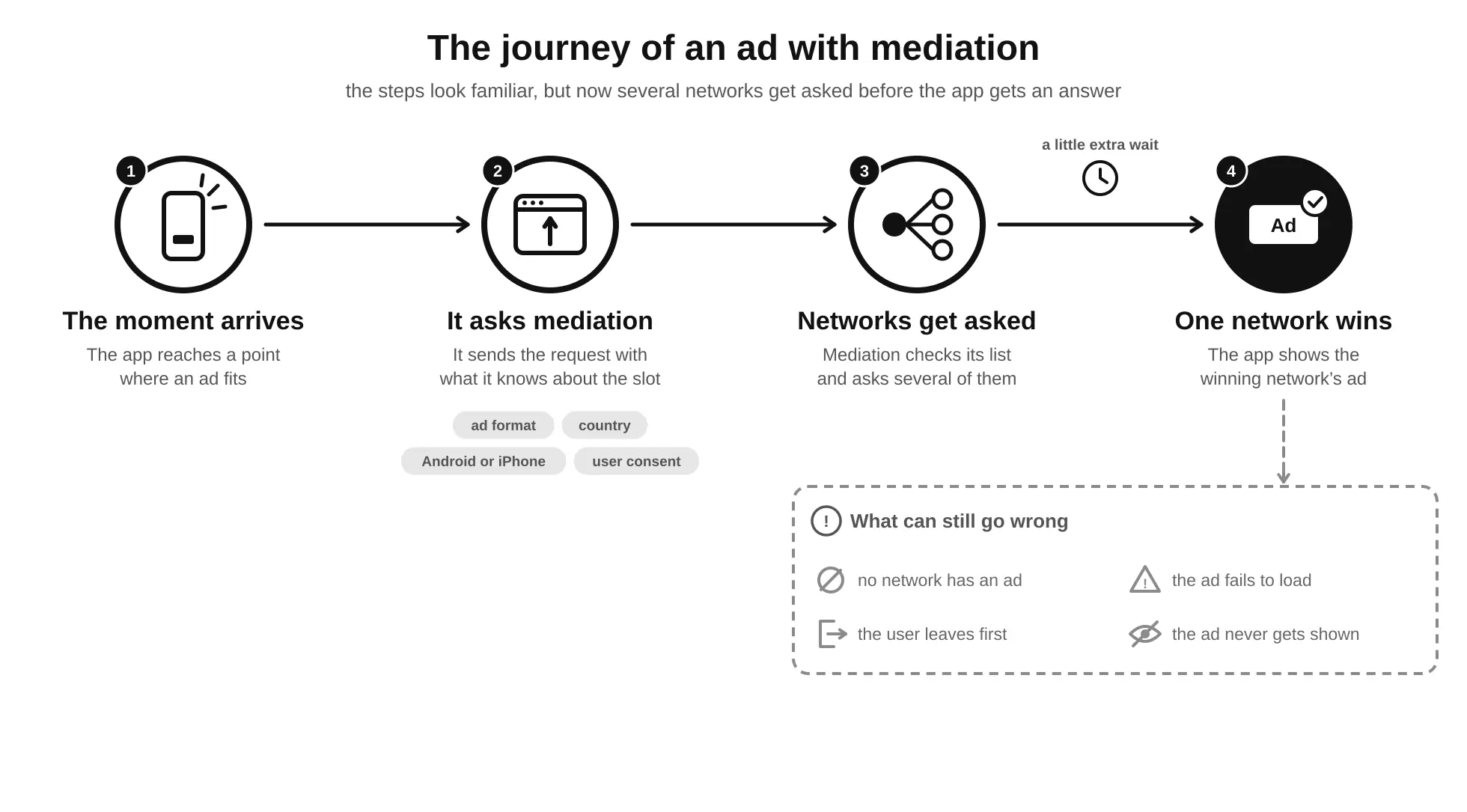
Everything starts the same as always. The user reaches a point where it makes sense to show an ad. It could be a screen with an ad fixed at the bottom, the end of a level in a game or the moment someone taps “watch a video to get an extra life”. In this first step, there’s no difference between working with one network or with mediation. Mediation decides who gets the slot, but not whether there should be a slot. That decision is still yours, and it’s the one we covered in the third article .
The request reaches mediation
Here’s the first change. With a single network, your app asked it for the ad directly. Now it asks mediation. What doesn’t change is that the request isn’t sent blind. It includes what’s known about the slot: what ad format it needs, which country the app is being used in, whether it’s an Android phone or an iPhone and, where relevant, whether the user has agreed to receive personalized ads.
The difference lies in what happens with that information. An ad network uses it to search its own advertisers for someone who might be interested. Mediation, on the other hand, doesn’t start by looking for advertisers but for buyers. It checks your setup to see which networks can take part in that particular slot. And you’re the one who picks those networks. They don’t have to be the same every time. You could have four networks competing for full-screen ads in Spain and only two for small ads in another country.
Mediation asks several networks
This is the step that makes all the difference. In the first article we saw that, inside an ad network, advertisers bid against each other for every slot and the best offer wins. That still happens, but now it happens inside each of the networks taking part. Mediation adds another competition on top. Each network turns up with the best it has found among its advertisers, and mediation compares those offers against each other. Put simply, it’s a competition of competitions.
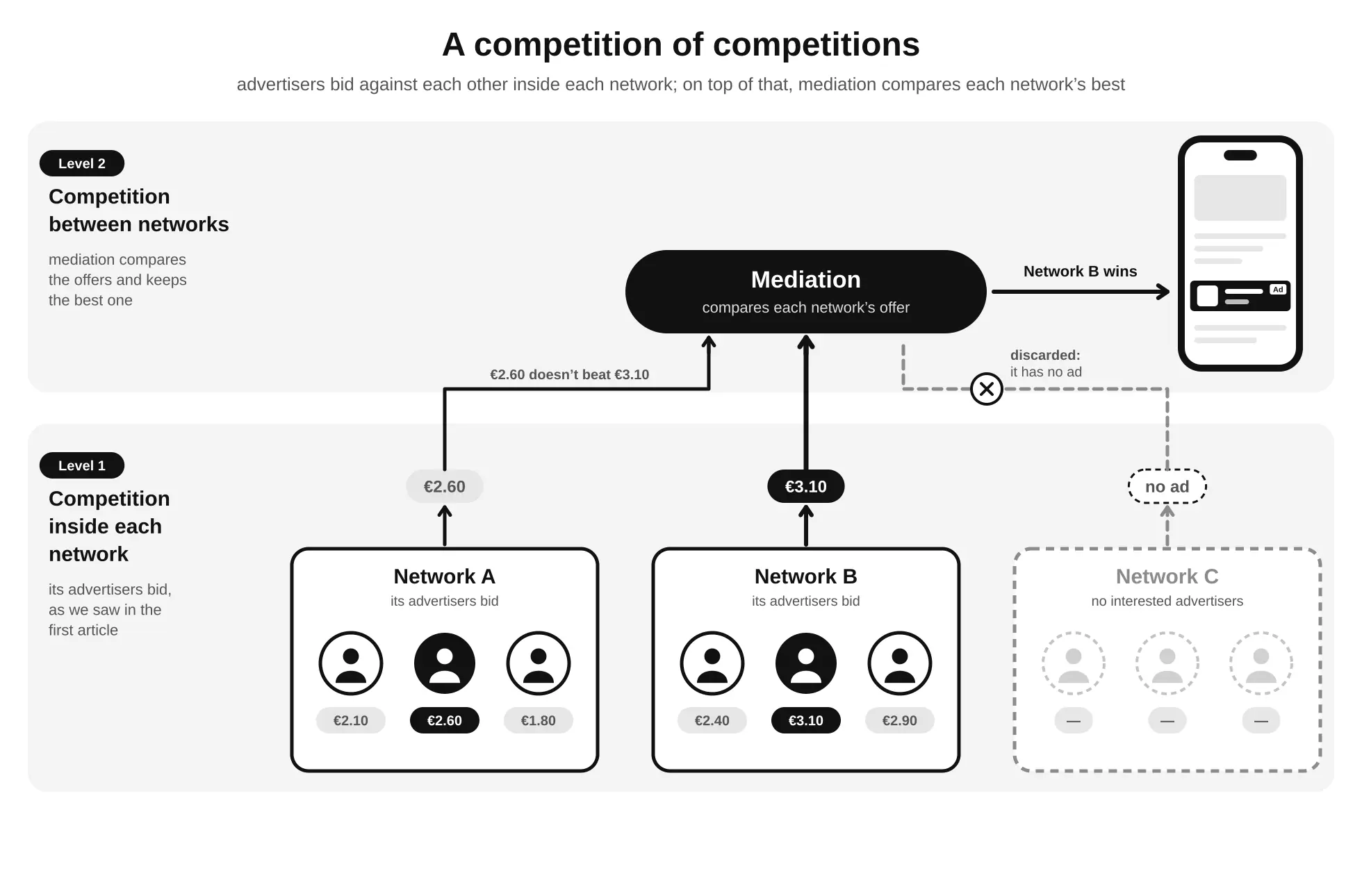
To run that competition, mediation can ask the networks one at a time, in a set order, until one of them says yes. It can also ask them all at once, let them bid and keep the best offer, or combine both approaches. Which one is used, and how it’s set up, has a big impact on how much you end up earning. That’s exactly what we’ll go through in detail in the next article.
One network wins and your app shows the ad
With a single network, “I’ve got nothing for you right now” meant the slot went unfilled. With mediation, that answer is no longer the end of the road. It’s just one less network in the running. The slot only stays empty if none of them has anything to offer.
Once there’s a winning network, your app loads its ad through that network’s component, which is built into the app. From there, the journey goes back to the one we already knew, with the same possible stumbles. The ad might fail to load. The user might leave the screen before it’s ready. Or it might load and, for whatever reason, never actually get shown.
This matters. Mediation improves your chances of finding an ad, but it doesn’t guarantee the user will ever see it. And there’s one difference that works against it. Asking several networks takes longer than asking just one. If the wait drags on, the user may have left before the ad appears. So whatever you gained by finding it, you lose by not showing it.
What mediation can do for you
Now that the journey is clear, let’s look at where the improvements come from. There are four, and not all of them are directly about money.
Fewer empty slots
This is the easiest one to understand. If one network doesn’t have an ad for a slot, there’s a good chance another one does. In our app, each of those 6,600 daily opportunities that went to waste in the second country would get a second or third shot at finding an advertiser.
Better prices
This is the least visible improvement and often the most valuable. Every network has different advertisers, with different interests and budgets, so the same slot isn’t worth the same to all of them. With a single network, you get whatever that network is willing to pay. With several of them competing, you get whatever the one that values it most is willing to pay. This improvement can show up even in countries where empty slots were already rare, like Spain in our example.
Not depending on a single company
If all your advertising depends on one network, you also depend on its decisions. It might lower its prices, run into technical problems, lose interest in your country or your type of app, or even suspend your account. With several networks, a problem with one of them means you earn less, but it doesn’t wipe you out.
Knowing what’s going on
With a single network, all you can see is how that network performs. With mediation, you can compare which network shows you the most ads, which one makes you the most money, which countries or ad formats each one works best in and where most of the failures happen. These are questions you couldn’t even ask before, and their answers help you make better decisions.
So the benefit isn’t only financial. Mediation also gives you a much clearer view of your advertising.
What it’s going to cost you
So far it all sounds great. But it wouldn’t be fair not to give the other side of the coin the same amount of space.
The first cost is technical work. To connect your app to each network, you need to include a component from that network, what the industry calls an SDK. Mediation brings its own as well. Each of those components needs updating every so often, and any of them can break when you release a new version of your app. On top of that, together they make your app take up more space, which matters in countries where many users have modest phones or slow connections. And, as we’ve seen, asking several networks can also make ads take a little longer to be ready.
The second cost is management time. You no longer have a single setup, but one for every ad format, country and platform, and it all needs keeping up to date. You don’t have a single dashboard anymore either, but several. Each network counts things its own way, so it’s normal for the figures not to quite add up from one dashboard to another, as we saw in the previous article .
The third cost has to do with privacy. Every new network is one more company receiving information about your users. You have to disclose that, handle it in your consent notice and comply with their rules.
If there’s one thing to take away from this section, let it be this. Mediation can help you earn more from your ads, but it also makes your advertising more complex to manage.
That’s why it isn’t always a good idea to start with it from day one. A small app, with few users, almost all of them in the same country, and with a network that already fills its slots well, probably won’t earn enough to make the effort worthwhile. In that case, your time may be better spent improving the product and getting users to come back.
How to tell if it’s right for you
If mediation isn’t for everyone or for every stage, how do you know whether it’s for you? There are five things worth looking at before you decide.
How many ads you show
If your product shows few ads, there’s little to share out between several networks and very little data to tell whether any of them is adding anything. Many networks also need a minimum volume before they take a real interest in your slots. Mediation starts to make sense when an improvement of just a few percentage points adds up to enough money to justify the work.
Where your users are
This is probably the best clue. If you have users in very different countries, like the app in our example, you’re a clear candidate. What one network doesn’t cover in one country, another can. If almost all your users are in a single country where your current network works well, the potential improvement is much smaller.
Which ad formats you use
Not every network is equally good at every ad format. Some stand out with small fixed ads, others with full-screen ads and others with rewarded videos. If your product relies mainly on one particular format, what you want are the networks that are strong in that format, not necessarily the best-known ones.
Who’s going to look after it
This one tends to get overlooked. Mediation isn’t something you install once and forget about. Each network’s components need updating, the data needs reviewing, failures need spotting and the setup needs tweaking. If you work alone or with a very small team, think realistically about whether you’ll be able to put that time in. Getting it up and running might take a few days; keeping it running is an ongoing job.
Whether you can already measure the basics
Before adding anything, you should at least be able to tell how many times your app asks for ads, how many times it finds one, how many are actually shown, how much is paid for them and how much you earn in total. If you aren’t clear on those numbers today, start with the previous article . Without knowing where you’re starting from, you won’t be able to tell whether mediation has made things better.
How to tell if it’s working
Let’s say you’ve taken the plunge. How do you know whether it was worth it? The underlying question is simple. Are you earning more per user than before, without the experience suffering? To answer it, you need to look at both sides. On one side, whether there are fewer empty slots, whether each ad pays more and whether you depend less on a single network. On the other, whether ads take longer to appear, whether they fail more often or, in the worst case, whether users come back to your app less.
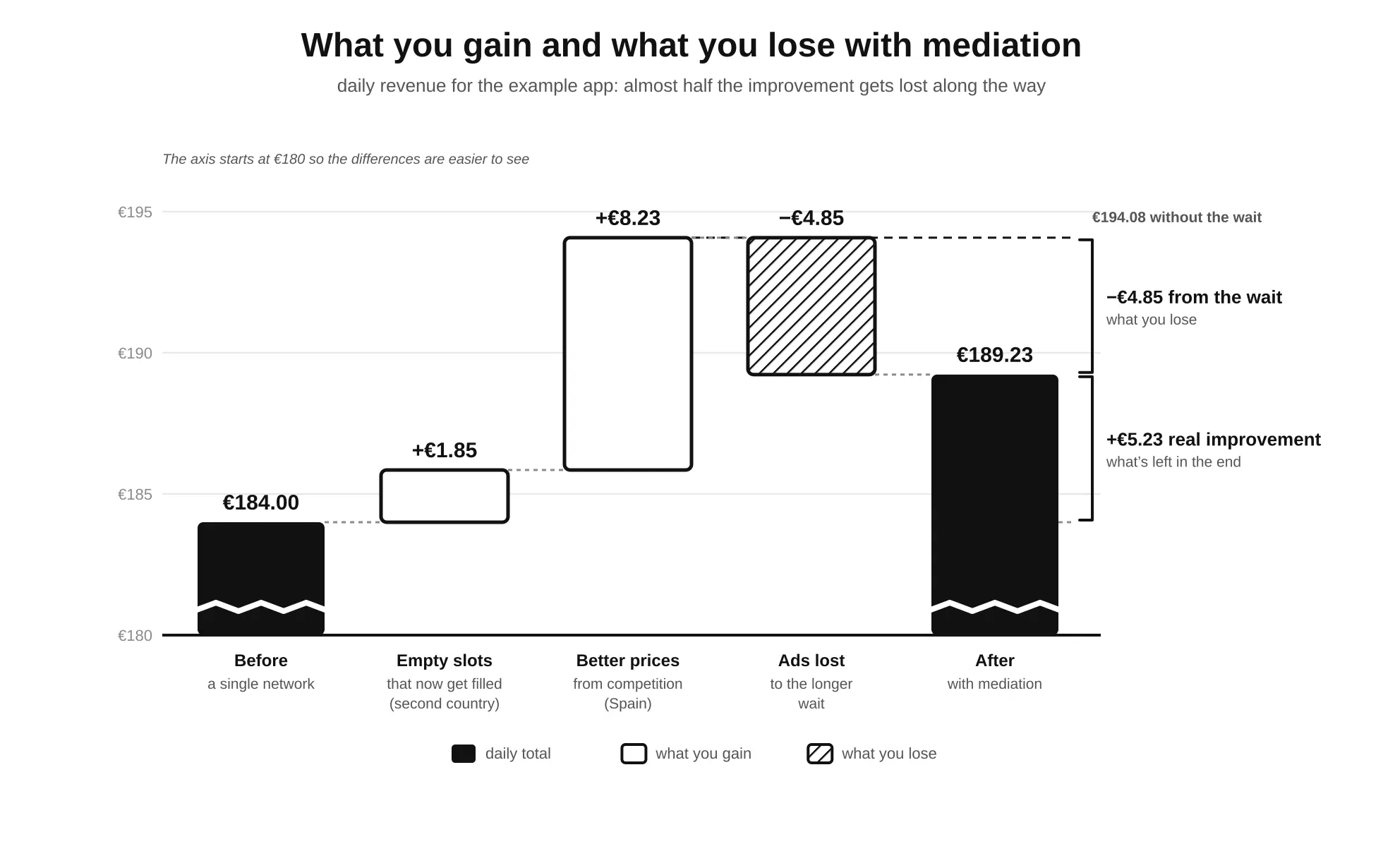
Let’s put some numbers on our app, purely as an example. Suppose a second network manages to fill half of the slots that used to go empty in the second country, even though it pays little: about €0.70 per thousand ads. That’s roughly €1.85 more a day. Suppose too that, in Spain, competition between networks means each ad pays 5% more. That’s about €8.23 more a day. All in all, around €10 more a day, a 5.5% improvement.
But now imagine that, because more networks are being asked, ads take a little longer to be ready and some users leave the screen before they see them. If, out of every hundred ads found, two more than before never get shown, it might seem trivial, but it affects every single ad in the app. That’s about €4.85 less a day, almost half of what was gained.
The example sums up how mediation works in real life. The improvements tend to be just a few points, and so do the costs. That’s why you should always look at them together.
This table can help you make sense of what you see after turning mediation on:
| What you see | What it probably means |
|---|---|
| More networks, but you earn the same | The extra effort isn’t paying off |
| Fewer empty slots, but each ad pays less | You’re filling more slots, but maybe too cheaply |
| Each ad pays more, but fewer are shown | Prices are up, but you may be losing volume |
| You earn more and ads are still shown just as often | Good sign: the improvement is real |
| You earn more, but more ads are lost along the way | You’re improving, but some of the gain is going to delays or failures |
| You earn more, but users come back less | Careful: what you earn today you may lose tomorrow |
And one last piece of advice we already gave in the previous article . Don’t rely on the total alone. Mediation hardly ever has the same effect across every country, platform or ad format. Breaking the data down is how you see which network is genuinely pulling its weight and which one is just taking up space.
What mediation can’t fix
To wrap up, it’s worth keeping expectations in check. Mediation is very good at solving one specific problem: getting more buyers to compete for your ad space. But it can’t work miracles with everything else.
If your ads appear at the wrong moment or too often, mediation won’t fix that, because that decision is made before any network gets involved. Nor can it make users come back to your app, because it doesn’t create users or visits. It won’t fix bugs in the way your app loads ads, a poorly designed consent notice or an ad format that doesn’t suit your product. It can’t conjure up advertisers in a country where there genuinely aren’t any. And if your traffic has quality problems, such as accidental clicks or suspicious visits, all it will do is show them to more buyers, who will end up noticing.
In all of those cases, adding more networks just spreads the same problem across more players. In other words, mediation is better at choosing who fills each slot, but it can’t turn a bad slot into a good one.
More competition, not more networks
Let’s go back to our app. Before, every time it needed an ad, it could only ask one buyer. Whatever that buyer didn’t want, or didn’t pay well for, was lost, and nobody knew how much. Now it can take every slot to the fish market, let several buyers compete for it and see what each one brings in every country and ad format.
But the goal was never to pack the market with buyers. It was to get just the right amount of competition to earn more, without the effort of managing it eating into the gains. In our example, the difference between getting it right and getting it wrong came down to a few euros a day.
If you only keep three ideas from this article, make them these. An ad network is a buyer for your ad space; a mediation platform is the fish market that gets several buyers competing for it. That competition can help you fill more slots, get better prices and depend less on a single company, but it doesn’t guarantee you’ll earn more, and it adds real work. So to know whether it’s worth it, counting how many networks you have isn’t enough. You need to look at how much you earn per user and what the experience is like for the people using your product.
There’s one question still hanging in the air, and it’s the one we’ve been dodging on purpose. When mediation asks several buyers, how does it decide who gets each slot? Does it ask them in turn, have them all bid at once or mix the two? And why can a bad setup mean selling an ad for less than someone was willing to pay? That, what the industry calls waterfall and bidding, is what we’ll cover in the next article in the series.
Happy earning!