Picture a user opening three different apps in the same afternoon: a casual game to kill time in a waiting room, a weather app to check if it’s about to rain, and a professional tool they use every day for work. All three could show ads. All three have users and, as we saw in the first article of this series , ad inventory available—spaces and moments where an ad could technically fit. But they shouldn’t be monetized the same way. Not even close.
In the game, that same person probably won’t mind watching a 15-second ad in exchange for an extra life that lets them keep playing—in fact, they’ll likely go looking for that option the moment they run out of tries. In the weather app, a discreet banner at the bottom of the screen can sit comfortably next to the forecast they came to check, much like an ad slot in a printed newspaper: it barely registers because it never competes with what the user actually came to do. But in the professional tool, a full-screen interstitial that pops up without warning—right as they’re about to save an important change—might be enough to send that user looking for an alternative that same afternoon. And they’ll probably find one.
If all three apps have users and inventory, why shouldn’t they use the same monetization model? When is an ad an annoying interruption, and when is it an option users actually appreciate? When does it make sense to offer a subscription, or simply let people pay to remove ads? And why can an app that shows far fewer ads sometimes generate more value than one showing three times as many?
This is the second article in the series on ad monetization. The first one ended with exactly that question: should every app be monetized in exactly the same way? The short answer is no. The long answer—what determines the right model for a given product, which options exist, and how to choose between them—is the rest of this article.
This piece is written mainly for people on the creative side of the screen: the ones who built a digital product—an app, a game, a tool, a content space—because they had an idea they wanted to bring into the world, and who are now wondering, maybe for the first time, whether advertising makes sense as a way to sustain it financially. You don’t need a business or growth background to get this decision right. In fact, understanding who your product serves and how you want it to feel to use—something any creative person already knows how to do—is half the job.
Before we go on, one important note on scope: this article won’t get into the details of each ad format, exactly where to place a banner or an interstitial, or optimal frequency caps. That’s for the third article in the series. Formats will come up today, but as tools in service of a product decision, not as the main event.
Monetization doesn’t start with picking an ad network
It’s tempting to treat ad monetization as a technical problem: integrate an SDK, create a few ad units, drop a banner somewhere in the interface, and wait for revenue to start rolling in. From the previous article, we already know there’s an entire real-time market behind that, with advertisers bidding on each opportunity in milliseconds. But even understanding how that market works leaves the most important question unanswered—the one that actually determines whether the project will hold up in the medium term: should this particular app be monetized with ads at all, and if so, how?
It’s an easy question to skip, precisely because the technical part can be solved in an afternoon: create an account, generate a few ad units, paste in a snippet of code, and there’s a banner on screen. That speed is deceiving. It feels like a business decision has been made when really, all that happened was flipping a switch. The actual business decision—which model, how much ad pressure, at what moments—often never gets thought through, and ends up inherited by default from whatever competitors do or whatever a tutorial happened to show first.
Monetization doesn’t start by picking an ad network or placing a banner. It starts by understanding how users behave, what value they get from the app, and which parts of that experience can carry advertising without being damaged by it.
That decision mostly comes down to three things: what problem the app solves, what the user is doing at any given moment, and how often—and for how long—they keep coming back. Let’s go through each one, because together they point almost directly to the monetization model that makes sense for a given product.
What problem the app solves
Entertaining someone is not the same as informing them, and informing them is not the same as helping them manage their money. Entertainment, information, communication, one-off utilities, productivity, education, finance, health, gaming: each category carries its own tolerance for interruption, and that tolerance has less to do with personal taste than with what’s at stake if something goes wrong.
The more important, sensitive, or professional the task at hand, the less tolerance a user tends to have for anything getting in the way. Nobody minds a banner much while skimming the day’s headlines or half-listening to a podcast in the background: those are low-stakes moments, where an interruption costs, at most, a second of attention. But that same person would probably react very differently if that banner popped up while filing a tax return, checking their bank balance, or exporting a project they’ve spent the whole afternoon working on. It’s not that they’re more or less tolerant by nature—it’s that the cost of a mistake, or even just a distraction, is completely different in each case.
Think also about products with a clearly creative or professional side—a photo editing app, an audio editor, a design tool, a task manager for teams. In all of them, the user is investing time and attention in producing something, not just consuming it. That difference matters enormously when deciding whether advertising has a place there, and if so, what kind.
What the user is doing in the moment
Beyond the type of app in general, what matters is what the user is doing at the exact instant an ad would appear. Passively consuming content—reading, watching, listening—is not the same as actively completing a task, waiting on a result, competing against other users, unlocking something they’re after, or repeating an action mechanically.
Advertising works best when it respects the goal the user already had before the ad showed up. An ad that feels like a natural part of that goal—a reward in exchange for an extra life, say, or a natural pause between two tasks—lands completely differently than one that gets in the way of what the user was trying to do. The difference isn’t really about the ad format; it’s about whether the user feels the ad is working with them or against them at that specific moment. It’s the same logic behind why an ad during a break in a football match barely registers, while one that cuts into the broadcast right as a goal is scored feels like an outrage: the content and the timing matter just as much as the ad itself.
How often—and how—the user comes back
This is where we connect to something the previous article already introduced: repeat usage. A daily-use app is not the same as an occasional one, a long-session app is not the same as one used in bursts of a few seconds, and a product with lots of internal transitions—screens, sections, levels—is not the same as one built around a single, specific action, like scanning a document or converting a file.
This variable connects directly to retention, ARPDAU, and LTV, both of which we covered earlier. The goal of a good monetization strategy is never to maximize impressions within a single isolated session, but to maximize the accumulated value of users who keep coming back. An app that a user opens 40 times a month has far more opportunities to generate sustainable revenue—with moderate ad pressure each session—than one that same user opens once and never touches again. Put another way: a user who sees one discreet ad a day for a year is a much better deal than one who’s shown ten aggressive ads on their only visit and never comes back.
This has a very practical implication for anyone building a product for the first time: if your app still has low repeat usage—if most users open it once and never come back—the urgent problem isn’t which monetization model to pick, it’s why people aren’t returning. Advertising can support a product that already retains users. It won’t fix one that doesn’t.
With these three factors on the table—the problem the app solves, what the user is doing, and how often they come back—we can now get into the available monetization models and when each one makes sense.
The main monetization models
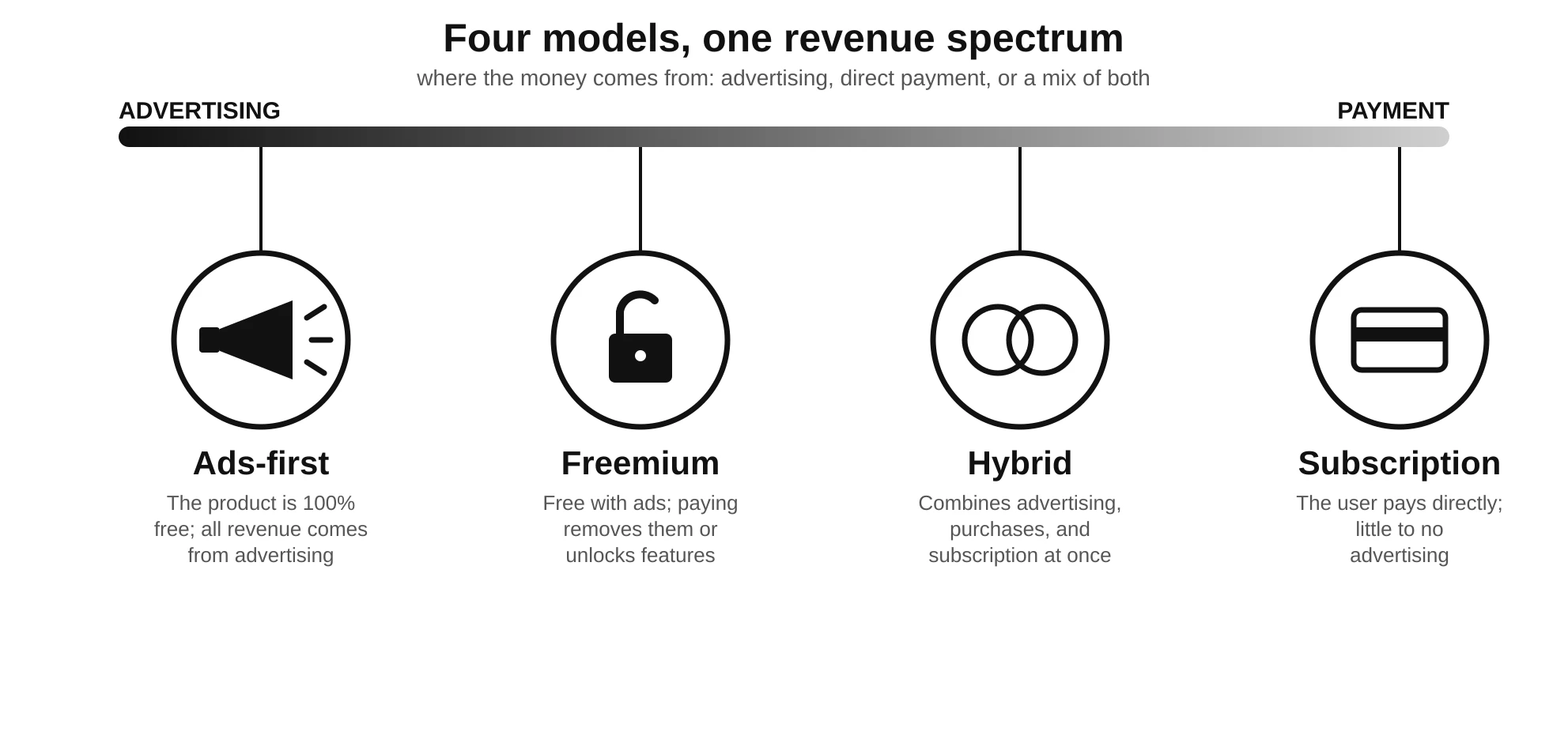
Before getting into each model, one idea is worth spelling out: no model is inherently better than another. There’s no hierarchy where subscriptions are somehow “nobler” than advertising, or where ads-first is a “lesser” tier. These are different tools, each with its own fit, its own risks, and its own revenue ceiling. The question is never which model is best in the abstract, but which one is most coherent with the product you’ve built and the relationship you want with the people using it.
Ads-first
In an ads-first model, advertising is the main—or nearly the only—source of revenue. The product is free, with no paywall of any kind, and the entire business rests on the ad inventory its audience generates. It’s probably the most intuitive model for anyone just starting out: no pricing tiers to design, no paywall to build, no one to convince to pull out a credit card. All it takes is people using the app.
It makes the most sense when a product needs to be free in order to grow—for example, because its value depends on having lots of people using it, as with social or content apps—when there’s a large potential audience, when users generate many sessions or page views, and when that audience is reasonably tolerant of some advertising in exchange for paying nothing. Think of news apps, content aggregators, highly accessible casual games, or simple, frequently used utilities: they all share a pattern of high volume and low entry friction, which is exactly the ground where ads-first performs best.
The risks are just as clear: an almost total dependence on user and session volume, which means any drop in traffic translates directly into a drop in revenue, with no cushion to absorb it. There’s also the temptation—a very real one, and easy to justify in the short term when revenue dips—to crank up ad pressure to compensate, which, as we saw in the previous article, tends to feed a vicious cycle: more ads, worse experience, more churn, fewer users, and revenue that drops again shortly after. On top of that, there’s direct exposure to swings in eCPM or market demand—which shift with seasonality, geography, and plenty of other factors already covered—and a structural difficulty monetizing your least active users, who generate few sessions and therefore little inventory, no matter how much they “show up” in your install stats.
Freemium with ads
In the freemium with ads model, users get the app for free while putting up with advertising, and have the option to pay to unlock extra features, remove usage limits, or get an ad-free experience.
The difference from ads-first is subtle but important: here, advertising isn’t necessarily the whole business—it’s the layer that gives people free access to a limited version of the product. The real business can end up living in both the ad revenue and the conversion of some of those free users into paying ones. It’s a common model in productivity, editing, or creative apps: the ad-supported free tier acts as a genuine showcase for the product—users actually try it, with their own files and their own use case—and some of them end up paying once the product has already proven its worth, not before.
An underrated advantage of this model—one that tends to fit products born from a specific creative idea particularly well—is that it doesn’t force a choice between “free with ads” or “paid” on day one. It lets you launch with ads to validate that the product has real traction, and then gradually introduce whichever features or tiers make sense to charge for, once you have a better sense of what your most engaged users would actually be willing to pay for.
Hybrid model
The hybrid model combines several revenue streams at once: advertising, in-app purchases, subscriptions, virtual currency, premium features, or the option to remove ads through a one-time or recurring payment.
This model is especially useful when your user base contains very different willingness to pay. Part of your audience will never pay for anything and will generate revenue purely through ads; another part will be open to the occasional purchase; and a third group—usually the smallest—may turn into recurring paying users. It’s a pattern that shows up in almost any digital product at sufficient scale: a small minority of highly engaged users produces a disproportionately large share of paid revenue, while the much larger majority sustains the business through ad volume. A well-designed hybrid model tries to capture value from all three groups at once, instead of forcing everyone down the same path—and, crucially, without making the people who’ll never pay feel bad about it, since they’re still contributing value through their attention to ads.
The main challenge with a hybrid model isn’t technical—it’s about coherence. Each layer needs to feel like an option, not a penalty. “You can remove the ads if you want to” sends a very different message than “we’ll bombard you with ads until you pay,” even though, underneath, both phrases describe the exact same business system.
Subscription or payment as the main model
For some products, a subscription or a payment—one-time or recurring—makes more sense as the primary model, leaving advertising in a secondary role or out of the picture entirely.
This tends to be the case when an app solves a recurring problem the user comes back to again and again, when it delivers clearly professional or financial value, when the task demands sustained concentration, or when the product is premium by nature and advertising would undermine the very thing the user is paying to avoid. Think advanced editing tools, personal finance apps, meditation or wellness apps, or any product where users themselves say, unprompted, “I’d pay for this without a second thought if it saves me time or gives me peace of mind.” When that kind of sentence comes up spontaneously in conversations with real users, it’s usually the most reliable sign that payment, not advertising, is the right path.
It’s also worth remembering that a subscription model is perfectly compatible with staying small or niche. In fact, it tends to work best precisely when the audience is small but highly engaged: a thousand people willing to pay a reasonable monthly fee can sustain a product just fine, whereas those same thousand people, seen purely as ad inventory, would generate revenue so small it’s almost irrelevant.
When ads might not be a good idea at all
And there are cases where advertising simply isn’t a good idea, no matter how much the rest of the market relies on it. Professional tools where trust and concentration are the product itself, and where any distraction translates directly into lost productivity for the person paying for your product with their time. Financial apps, where a badly timed interruption can trigger a costly mistake—a misconfirmed transfer, a mistyped figure. Privacy-focused products, where the ad model itself, which often involves sharing signals with third parties, can directly conflict with the very value proposition the product is selling. Experiences aimed at children or vulnerable users, where ad pressure raises ethical considerations that go well beyond the business side and deserve to be taken seriously, regardless of what the minimum applicable regulation says. And, in general, any product where a poorly placed interruption could cause a real mistake or loss of data for whoever is using it.
It’s worth saying plainly, because people sometimes assume the opposite: choosing not to monetize with ads isn’t “leaving money on the table.” Sometimes it’s simply the decision that protects the product and lets you charge what it’s actually worth.
Ad formats, as tools for a decision
Before continuing, a quick note: this section is deliberately just an overview. A detailed breakdown of each format—when to place it, how often, in exactly which placement—is the whole focus of the next article in the series. Here, we just want a general sense of which formats exist and which model and experience they naturally fit best, so the model you choose today doesn’t clash head-on with the formats it would make sense to use tomorrow.
Banner. A fixed ad slot, usually at the top or bottom of the screen. Works well on content or lookup screens, and in recurring-use tools where it can sit alongside the task without getting in the way too much. To work well, it needs to occupy a stable space reserved from the start, and it shouldn’t pop in or out in a way that shifts the rest of the interface—few things annoy people more than a button moving at the last second because a banner just loaded above it. Its main risks are visual fatigue from being constantly present, a relatively low value per impression compared to other formats, refreshing too often, and accidental clicks when it sits too close to important interface controls.
Interstitial. A full-screen ad that briefly interrupts the app. Works well at clear transition points: after finishing a task, between game levels, or when moving from one section to another—moments when the user has already mentally closed out what they were doing and hasn’t yet started the next thing. What it should never do is show up mid-action, or right after the user taps an important control: that’s by far the most common monetization mistake, and the one that destroys trust in a product the fastest.
Rewarded. An ad the user chooses to watch voluntarily, in exchange for a specific reward: an extra life, unlocked content, a second chance, extra time. The key idea behind this format is that the user is accepting an explicit trade; they’re not suffering an interruption, they’re making a decision. It’s probably the best-perceived format of all, precisely because it flips the usual logic: instead of “I’m interrupting you to sell you something,” it says “here’s something in exchange for your attention, and it’s your call.”
Rewarded interstitial. A variant that combines the full-screen format of an interstitial with the reward logic of a rewarded ad. Worth introducing carefully, since it requires clearly explaining what’s being offered in exchange, respecting the moment it appears in, and always letting the user opt out without any real penalty. Without those three conditions, this format can end up feeling like a regular interstitial dressed up as a reward, which usually backfires harder than an honest interstitial would.
Native. An ad designed to visually blend in with the content around it. Can work well in feeds, lists, articles, and catalogs. What matters here is always keeping a clear line between content and advertising: a native ad should never be designed to mislead people about what’s editorial content and what’s paid advertising—not just for ethical reasons, but because users who feel tricked once tend to stop trusting everything else the app publishes.
App open. An ad that can accompany certain returns to the app, typically when the user comes back after being away for a while. It shouldn’t show up on every brief resume—say, after checking a notification for two seconds, which can happen dozens of times a day—and it shouldn’t block the user when they need to get to a feature right away. It needs well-thought-out frequency caps and should take advantage of a genuinely natural re-entry moment, not just any re-entry.
In-content banner. A term that can refer either to a banner embedded within a content screen or to a variant of a native ad. Whatever you call it, what matters is always the same: the context it appears in, the design it uses, and how clearly it stays visually separated from the editorial content around it.
A rough guide, not a strict rulebook
The table below is a rough guide to how product type, starting model, and candidate formats tend to line up. It’s not a fixed formula or a strict rulebook: every product has its own quirks that can pull it away from what this table suggests—your app might closely resemble one category and still have a good reason to do something different. The goal is only to offer a reasonable starting point for thinking it through, not a final answer meant to replace your own judgment.
| Type of product | Likely starting model | Candidate formats | Main thing to watch |
|---|---|---|---|
| Casual game | Ads-first or hybrid | Rewarded, interstitial between matches, secondary banner | Don’t interrupt mid-match |
| Content app | Ads-first | Banner, native, interstitial between pieces | Don’t blur content with advertising |
| Free utility | Light ads-first or hybrid | Banner, occasional rewarded | Don’t block the core task |
| Social app | Hybrid or embedded advertising | Native and feed formats | Don’t disrupt the conversation |
| Professional tool | Subscription, payment, or hybrid | Limited advertising or none | Protect trust and focus |
| Educational app | Freemium or subscription | Contextual rewarded, moderate banner | Avoid pressuring young users |
| Financial or sensitive app | Subscription, commission, or premium | Very limited advertising | Protect trust and privacy |
Format, placement, and timing: one decision, not three loose words
It’s not enough to say “we use interstitials” or “we have banners.” A complete monetization decision has to answer quite a few more questions: exactly which format, on which screen, after what specific user action, for which type of user, how often, what happens if the ad fails to load, and which metric will be used to judge whether the decision is actually working.
“Interstitial on the main screen” is an incomplete decision, barely more than a rough sketch—it names a tool but doesn’t say how it will be used. “Interstitial after completing an action, at most once every so often, and only for users who aren’t in the middle of a critical task” is starting to look like an actual product decision, because it accounts for the user, the context, and a sensible limit—not just the format.
This way of thinking—format plus context plus limit—is what separates teams that monetize well from teams that just “add ads.” You don’t need prior ad tech experience to reason this way; it just takes the same care you’d already put into designing any other part of the interface, and asking, for every single ad, “how would I feel if this showed up right here, right now?”
We’re deliberately not going to hand out universal frequency numbers here—no “one interstitial every three screens,” no “a maximum of five impressions a day.” Any number like that, stripped of context, would be about as unreliable as asking what counts as a good eCPM without any other information, which we already advised against in the previous article: it depends far too much on the type of product, the country, the average session, and dozens of other factors for a generic figure to serve as real guidance. The sensible approach is to measure and experiment by user segment, and arrive at those numbers with your own data instead of generic rules copied from another product that, however similar it looks, is almost never identical to yours.
Short term, long term: two ways of reading the same numbers
Any monetization setup can be looked at from two different time horizons, and it’s worth keeping both in view, because each one tells a different—and often contradictory—part of the same story.
In the short term, we look at impressions, eCPM, daily revenue, and Ads ARPDAU: figures that answer the question of how much we’re making today with the current setup. They’re comfortable numbers to watch because they react fast—change something in the morning, and by the afternoon the dashboard already shows a different figure.
In the long term, we look at retention, session length, return frequency, churn, LTV, and conversion to payment or subscription: figures that answer a much more uncomfortable question—whether that same setup is building the business over time or quietly eroding it. These numbers take much longer to read—sometimes weeks pass before the real effect of a change shows up—and that’s exactly why they’re the ones most easily ignored when there’s pressure to see results fast.
An ad setup can increase impressions and daily revenue while, at the same time, chipping away at app retention. That result shouldn’t automatically count as a win just because this week’s revenue chart is up—it’s exactly the kind of mirage that leads someone, two or three months later, to wonder why the active user base has dropped, without connecting it to a monetization change made well before. As the previous article already pointed out, maximizing the number of ads shown per session and maximizing the real value a user generates over time are not the same problem, even if they can look like it for a few days.
A simple way to guard against this mirage, without needing any sophisticated infrastructure, is to get in the habit of checking both horizons together before calling a change a success: if revenue is up in the first week but seven- or fourteen-day retention starts slipping, that revenue bump probably isn’t a win—it’s a bill that just hasn’t arrived yet.
A decision tree to help you get your bearings
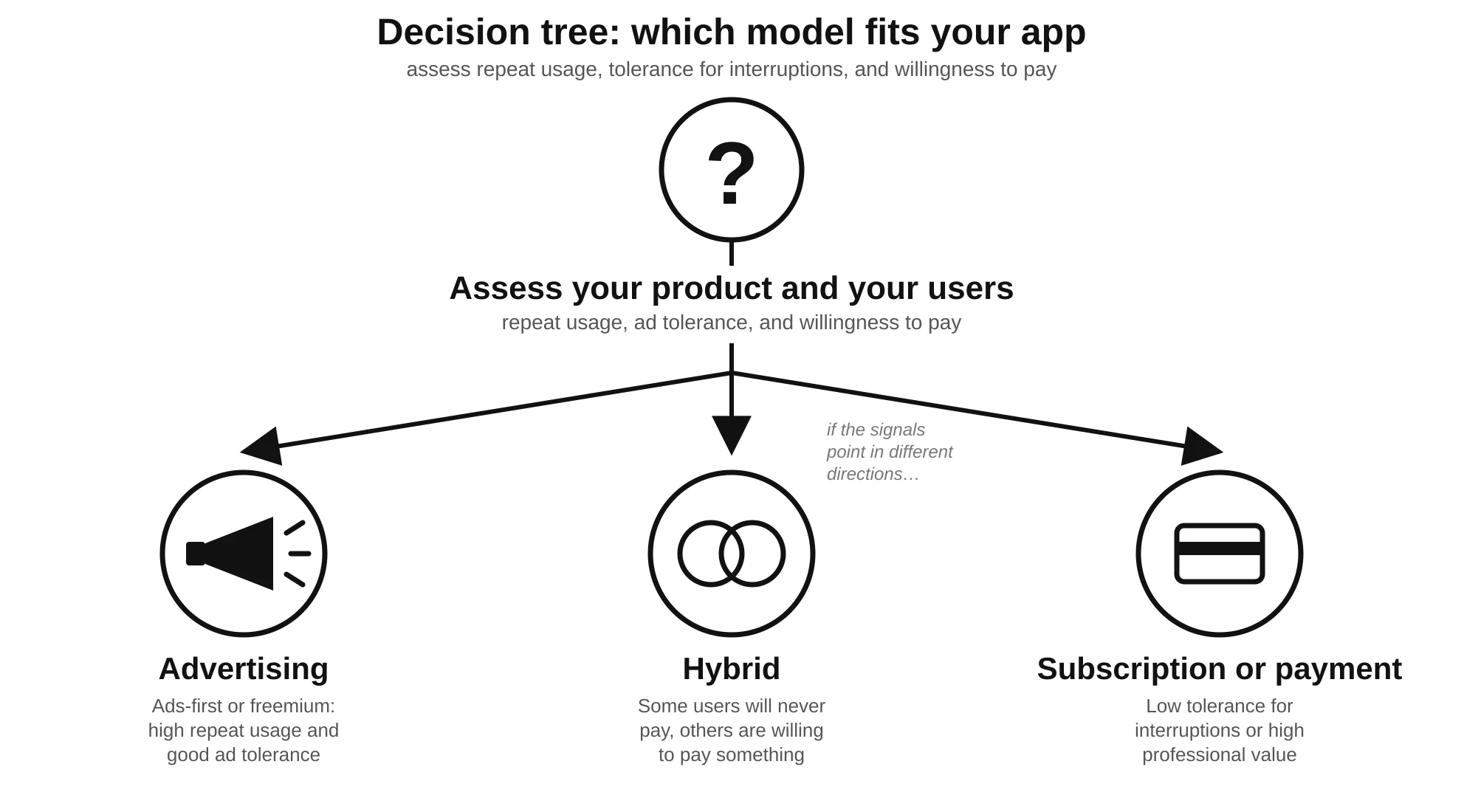
If you’re still not sure where to start, these questions can help point you in the right direction. You don’t need lab-grade precision to answer them—just be honest about what your product is really like today, not what you’d like it to be a year from now.
- Can the user complete their main goal without anything getting in the way?
- Does the product have enough repeat usage to generate ad inventory sustainably?
- Is there a clear, tangible reason someone would pay for this product?
- Would the user get real value out of removing the ads?
- Does the audience tolerate advertising without abandoning the app because of it?
- Does the product fundamentally depend on the user’s trust or concentration?
- Is the cost of acquiring each user high enough that you need to recover that value through purchases or subscriptions, not just advertising?
No single one of these questions has the definitive answer. But together, they usually point fairly clearly toward one of three outcomes: advertising as the main model, a hybrid model, or payment and subscription as the main model. If, while answering them, you notice your answers pulling in different directions—say, high repeat usage but also a heavy dependence on user concentration—that tension isn’t a mistake on your part. It’s usually the clearest sign that the right model is the hybrid one, not either extreme.
Three apps, three different calls
Let’s go back to where we started: the casual game, the weather app—now recast as a content app—and the professional tool. With everything we’ve covered, we can try to settle on a reasonable model for each one, using the same reasoning you could apply to your own product.
App A: the casual game. Lots of users, frequent sessions, and plenty of natural transitions between matches. Rewarded fits well as a voluntary trade—an extra life in exchange for watching an ad—interstitials can appear in a limited way between levels, riding on transitions the game already has, and there’s always room to offer an ad-removal purchase for anyone who’d rather pay than watch, which also captures the small group of most committed players. An ads-first or hybrid model looks reasonable as a starting point, and it’s perfectly compatible with layering in other revenue streams later if the game grows.
App B: the content app. A stable banner that sits alongside reading, some native ads woven naturally into the feed, and an interstitial that only appears between pieces or sections—never mid-article. The absolute priority here is that the ad never gets mistaken for editorial content, because that confusion doesn’t just hurt the advertiser—it erodes the reader’s trust in everything else the app publishes. Ads-first tends to work well, especially when content volume and traffic are both high and steady.
App C: the professional tool. Short sessions, but ones that carry a lot of value for whoever’s using them, with a user fully focused on a specific task and, likely, money or work time on the line. Here it’s probably better to prioritize a subscription, a one-time payment, or a freemium model, keeping advertising very limited—or leaving it out entirely—and only where it doesn’t put the user’s trust in the product at risk. For this kind of product, advertising is almost never the urgent problem; the urgent problem is usually proving enough value to justify a price.
Applied to any real product, the takeaway here is that none of these three apps has “the best format” in the abstract. Each one needs a model that’s coherent with how it’s actually used, and that model can—and probably should—evolve as the product and its audience evolve too.
Why not every app should be monetized the same way
Let’s close by going back to the question the previous article ended on: should every app be monetized in exactly the same way? We can now answer it with more precision than a simple “no.”
Not every app should be monetized the same way, because not every user has the same intent when opening an app, the same patience, the same usage frequency, or the same willingness to pay for what they get. Advertising can be the main model behind a business, the free entry point into a bigger product, a reasonable complement to purchases and subscriptions, a reward users choose to accept on their own terms, or simply the wrong choice for certain products.
The first monetization decision is never which ad to show. It’s deciding what experience you’re willing to protect, and what kind of long-term value you want to build with the people who choose to trust your product. Getting that decision right early on tends to save a lot of painful adjustments later—it’s much easier to introduce advertising thoughtfully from the start than to walk it back or tone it down after it’s already driven away the users you most wanted to keep.
Once you’ve settled on the model that fits your product, a much more concrete question remains: exactly where should each ad appear, and at what point in the experience? The next article in the series is dedicated to precisely that—formats and placements in depth—and to how to monetize without turning the experience into one constant string of interruptions.
Happy earning!